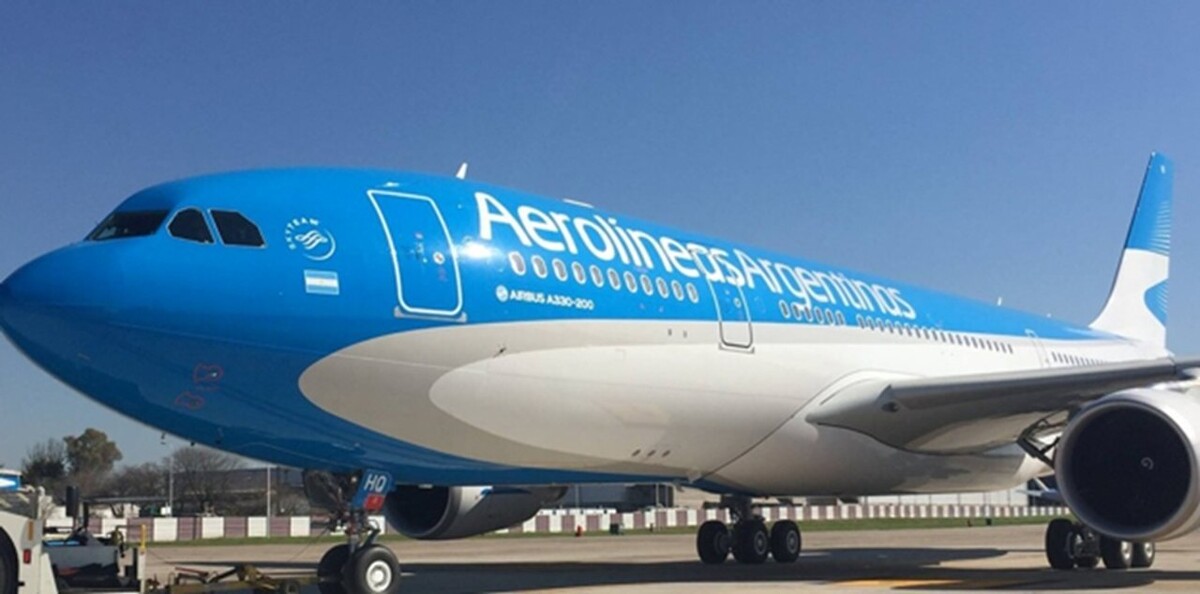
Buenos Aires, Feb 25 (NA)—Aerolíneas Argentinas presented the results of its fiscal year 2025, marking a definitive turning point, as for the first time since its renationalization in 2008, the company has not only managed to operate without resorting to transfers from the National State, but has consolidated an operating surplus of $112.7 million, as reported to the Argentine News Agency by sources from the state-owned company. This result is almost double the $56.6 million obtained in 2024, confirming a sustained growth trend and financial recovery. “Aerolíneas Argentinas has demonstrated that it can compete on equal terms with other companies in the industry, reaffirming its unwavering commitment to operational safety and the quality of its service,” the statement said. The balance sheet for the 2025 exercise is currently undergoing external audit by the consulting firm KPMG. This firm, which already certified the financial statements for 2024, expects to complete the validation so that the Board of Directors can proceed to the formal approval of the document by mid-year.
Aerolíneas Argentinas' performance in 2025 puts an end to the old paradigm that a state-owned airline is necessarily synonymous with losses and subsidies. Between December 2023 and the same month in 2025, Aerolíneas Argentinas managed to reduce its bank and financial debt by 41%, going from $341.9 million to $207.4 million. This financial relief allowed the company to move from a defensive posture to one of strategic expansion. The 2025 fiscal year broke this inertia, through the optimization of routes, the reduction of bureaucratic structures, and improvement in productivity, transforming a deficitary entity into a business unit that aims to be profitable and competitive. The profitability of 2025 was not the result of a cut in connectivity, but of better asset management. By doubling the surplus of the previous year and completely eliminating Treasury assistance, the company not only recovers its operational prestige but becomes a case study on the viability of professional management of state strategic assets. The challenge for 2026 will be to sustain these margins in an environment of increasing competition and to continue with the ambitious fleet renewal without compromising the recently achieved financial health.
In a move aimed at reducing long-term operating costs (especially in fuel consumption and maintenance), the company announced the incorporation of 18 new-generation aircraft: Four Airbus A330neo: Destined to strengthen long-haul international routes with greater energy efficiency. Eight Boeing 737 MAX 10: The highest-capacity version of the MAX family for domestic and high-density regional routes. Four Boeing 737 MAX 9 and two Boeing 737 MAX 8: Completing the modernization of the single-aisle fleet. Fabián Lombardo, President and CEO of Aerolíneas Argentinas, emphasized the importance of competitiveness in an open market. “This result affirms the direction we have adopted in the last two years, in which we focused on cost reduction and profit maximization.” The company maintained a volume of flight hours identical to that of 2024, but with significantly superior efficiency metrics: Passenger Volume: 12,781,016 people were transported, which is an average of 35,016 passengers per day. Load Factor: The airline reached a robust 83% occupancy on a network of 300 daily flights. Reliability: The on-time performance factor stood at 99.4%, a figure that positions the company among the most punctual and reliable in the region. User Experience: The Net Promoter Score (NPS) indicator, which measures customers' willingness to recommend the service, reached 55 points, reflecting a substantial improvement in the perception of quality.
Financial recovery and expansion plan One of the pillars of this operating surplus has been the aggressive debt reduction policy.